 By
By A Celebration of Boishakh, Inspired Anew
Pohela Boishakh is more than a celebration of a new year—it is an expression of Bengali identity, colour, heritage and renewal. For its April 2026 special issue, GLAMARTS Fashion & Media brings that spirit to life through a striking fashion story featuring acclaimed Bangladeshi actress Shabnam Faria.

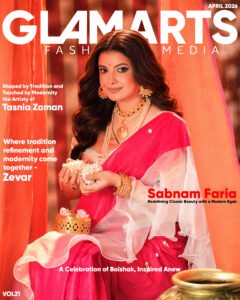
Captured through a series of richly styled portraits, Faria becomes the embodiment of a contemporary Bengali woman—rooted in tradition, yet confident enough to reinterpret it through a modern fashion vocabulary.
The editorial, titled “A Celebration of Boishakh, Inspired Anew,” explores three distinctive visual moods. Each look speaks a different language, yet together they form a cohesive portrait of Boishakh fashion: vibrant, feminine, artistic and unmistakably Bengali.

Tradition, Reimagined
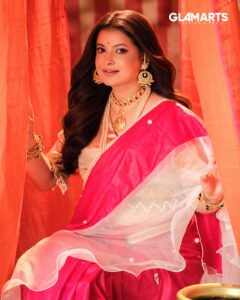
The first look immediately establishes the festive spirit. Draped in a vivid fuchsia and white ensemble, Faria appears against a warm palette of reds and oranges. The colour combination is quintessentially celebratory, but the styling moves beyond conventional Boishakh dressing.
The bright pink sari creates a powerful visual statement, while the sheer white pallu introduces softness and movement. Pearls layered across the neckline add a touch of classic refinement, complemented by ornate earrings, bangles and a statement nose ring.
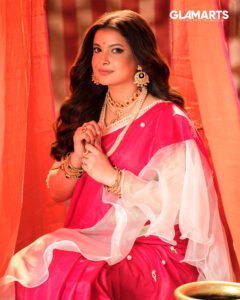
Here, tradition is not treated as something static. Instead, it becomes a foundation for contemporary expression.
Faria’s flowing hair and defined eyes balance the richness of the ensemble, creating a look that feels glamorous without losing its cultural character. The result is a distinctly modern interpretation of festive Bengali femininity.
This is Boishakh through a lens of confidence—bold, colourful and unapologetically celebratory.
A Garden in Bloom
The second look shifts dramatically in mood.
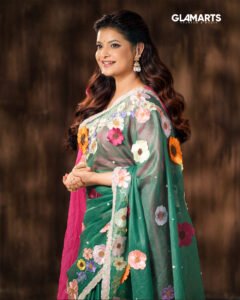
A translucent deep green sari covered in colourful floral embroidery transforms Faria into a living canvas. Pink, orange, lavender, white and blue flowers are scattered across the fabric, creating the sensation of a garden in full bloom.
The contrast between the rich green base and multicoloured floral motifs gives the look a youthful, joyful energy. The sheer quality of the sari adds lightness, allowing the embroidery to remain the central visual element.
The pink blouse underneath introduces another layer of colour, creating a playful dialogue between the sari and the styling.
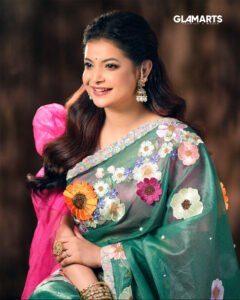
Jewellery remains deliberately decorative rather than overpowering. Traditional earrings and bracelets complement the embroidery while allowing the clothing to command attention.
The beauty styling follows the same philosophy.
Faria’s softly sculpted complexion, expressive eyes and flowing waves create a romantic silhouette, while the subtle bindi anchors the look firmly within Bengali cultural aesthetics.
It is perhaps the most poetic look of the editorial—where fashion meets nature, colour and the optimism of a new beginning.
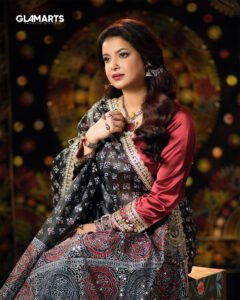
The final look takes an unexpected turn. Moving away from the conventional red-and-white Boishakh palette, the editorial introduces a black sari with intricate geometric motifs, red accents and elaborate traditional borders, paired with a deep burgundy blouse. The effect is dramatic. The darker palette gives Faria a more mature and sophisticated presence. The sari’s intricate patterns create visual depth, while the richly embellished borders bring a sense of heritage craftsmanship to the look.
The jewellery becomes more expressive here. Statement pieces featuring coloured stones, layered bangles and sculptural hand jewellery complement the sari’s elaborate detailing. Rather than simply accessorising the outfit, the jewellery becomes part of its visual narrative.
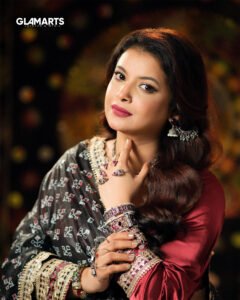
Faria’s beauty styling also becomes more defined. Her voluminous hair, dramatic eyes and deeper lip colour create a striking contrast against the black and burgundy ensemble.
This look demonstrates that Boishakh fashion does not have to be limited to a single colour story. Tradition can be interpreted through mood, texture, silhouette and attitude.
The Art of Styling
One of the strongest elements of the editorial is its attention to balance. The fashion does not compete with Faria; it works with her. Every look has been constructed around a clear relationship between colour, texture, jewellery, beauty and composition. The styling moves between three distinct emotional spaces:
Celebration in the vibrant pink and white look.
Romance in the floral green sari.
Mystery and sophistication in the black and burgundy ensemble.
This progression gives the editorial a cinematic quality. Rather than presenting three unrelated outfits, the images feel like chapters of the same visual story. The photography further enhances this approach. Warm lighting, deep shadows, controlled backgrounds and carefully composed portraits create an atmosphere that feels simultaneously luxurious and intimate. The use of rich reds, greens, golds and earthy tones reinforces the visual connection to Bengali festive culture.
Shabnam Faria: A Contemporary Bengali Muse
At the centre of the story is Shabnam Faria. Known for her versatility as an actress, Faria brings a natural sense of character to each frame. Her expressions shift effortlessly—from the warmth of a gentle smile to a more contemplative, sophisticated gaze.
That versatility becomes particularly important in a fashion editorial. The clothes are elaborate, but the photographs remain centred on the woman wearing them.
Faria’s presence gives the looks personality.
She does not simply model the garments; she inhabits each visual world created around them.
Boishakh Beyond Red and White
Perhaps the most interesting aspect of this editorial is its refusal to define Pohela Boishakh through only the familiar red-and-white combination.
Red and white remain an important part of Bengali New Year aesthetics, but this story expands the palette. Pink, green, orange, burgundy, black, gold and multicoloured embroidery all become part of the celebration.
That evolution reflects the changing nature of fashion itself.
Heritage continues to inspire, but today’s Bengali woman is free to interpret that heritage in her own way. She can be traditional without being conventional, glamorous without being excessive, and contemporary without becoming disconnected from her roots.
A New Year, A New Expression
For GLAMARTS, the April 2026 cover story is ultimately a celebration of this balance.
Through Shabnam Faria, the editorial presents a vision of Bengali fashion that respects its past while embracing its future. The intricate textiles, traditional jewellery, floral embroidery and cultural references remain deeply familiar, yet the styling, silhouettes and photographic language give them a distinctly contemporary identity.
“A Celebration of Boishakh, Inspired Anew” is therefore more than a festive fashion shoot. It is a visual conversation between heritage and modernity, tradition and individuality, colour and character.
And at the heart of that conversation stands Shabnam Faria—elegant, expressive and unmistakably contemporary.
GLAMARTS April 2026
Pohela Boishakh Special
Featuring: Shabnam Faria
A Celebration of Boishakh, Inspired Anew
Shaped by Tradition and Touched by Modernity — The Artistry of Tasnia Zaman